ML Engineer — production LLM systems, evaluation & AI safety

I build systems that have to work when the stakes are real.

I grew up around my family’s jewellery business in Sonipat, went on to ship ML in British banking, and now focus on empirical AI safety in the UK.

I like building things that have to work: models a bank can trust, a trading system that knows when to stop, an ERP my dad actually uses.

now: Transitioning into empirical AI safety research and evaluation roles. more

quality_gate.sh

$ judge --run 2817 --metric faithfulness --judge deepeval

# input

“Client said their fixed-rate ISA matures in March and they’re thinking of using some savings to help their daughter buy a flat. Also asked about consolidating old pensions.”

# output scoring

  • FAITHFULISA matures in March↳ Directly stated in the note.
  • FAITHFULInterested in pension consolidation↳ Directly stated in the note.
  • ESCALATEWants a mortgage for daughter↳ Over-reach: the note says “help their daughter buy a flat”, not a mortgage request. Routed to a human.
  • BLOCKEDHolds £50k in savings↳ Hallucinated: no amount appears anywhere in the note.

judging▍

synthetic data · hover a line to trace its evidencehallucination gate <5%PII masked
8+years shipping ML in regulated settings
95%extraction accuracy target, sustained in production
<5%hallucination rate, gated on every run
Tier 4/5Model Risk & AI Ethics review, taken to live release

My story

From a jewellery shop in Sonipat to AI safety

I grew up in Sonipat, in a family that has run a gold jewellery business for years. I did a B.Tech in Chandigarh, then started my career at Wipro in Mumbai, building customer-value models and an A/B-testing framework for a large corporate web estate.

That’s where I learned how software gets built at scale — and how much I wanted to work on the “why” behind the data, not just the plumbing. That pull took me to Warwick for an MSc in Business Analytics, and from there into data science in the UK.

Today I’m a Senior Data Scientist in NatWest’s Wealth AI Hub. I build LLM systems that turn messy relationship-manager notes and call transcripts into structured insight, in a bank where getting it wrong isn’t an option. Most of my work is about making models trustworthy enough to put in front of regulators and clients.

The move into AI safety is a deliberate one: from shipping models that work to making sure increasingly capable ones stay robust, predictable and aligned with what people actually intend.

Selected work · NatWest Group — Wealth AI

A production LLM system, made trustworthy

Designed and built from nothing an LLM system that extracts structured advice and product opportunities from unstructured adviser notes and call transcripts — then built everything needed to let it run where its outputs matter.

● 95% accuracy targethallucination <5%Tier 4/5 Model RiskAI Ethics review
# architecture · production LLM pipelinehover or tap a node
passuncertainfailapproveNotes & callsunstructuredIngestdelta loadsMask PIIbefore any modelExtractLLMJudgeLLM-as-JudgeDelivertraceable outputHuman reviewsupervisorBlockedlogged, not shown
Judge

An LLM-as-Judge scores accuracy, faithfulness and duplication on every run — calibrated against human-reviewed references, acting as an automated quality gate.

safety control

Evaluation as a quality gate

An LLM-as-Judge methodology (DeepEval), calibrated against a human-reviewed reference set, scoring accuracy, faithfulness and duplication on every run. Sustained accuracy against a 95% target with hallucination held below 5%.

Governance to live release

Took the system through Tier 4/5 Model Risk and AI Ethics review — authored the risk documentation, remediated formal findings on PII-masking coverage and end-to-end output traceability, and evidenced closure.

Human oversight by design

Extended the system into compliance review: automated a nine-point checklist across 100+ real calls, benchmarked against expert-completed references, routing the ~10% of cases that need supervisory review to a human.

Monitoring for drift

A production dashboard pairing a model lens (accuracy, hallucination rate, PII coverage, cost-to-run) with a business-outcome lens, backed by monthly human validation cycles.

Philosophy

Four rules I keep coming back to

I am moving full-time into empirical AI safety — taking that practical grounding in evaluation and oversight to the harder version of the same problem: as models become more capable, how do we know they are doing what we intend?

  1. rule_01

    Calibrate the judge before trusting it

    An LLM-as-Judge is just another model. Mine is scored against a human-reviewed reference set first — only then does it get to gate releases.

  2. rule_02

    Fail closed, not confidently

    If a step that grounds the answer fails, store nothing and say why. A confident output with invented facts is worse than no output at all.

  3. rule_03

    Authority to act is earned

    Agents start by suggesting. Only a track record of being right unlocks small reversible actions — consequential ones come last.

  4. rule_04

    Route uncertainty to a human

    Automate the confident majority and send the rest to a person, with the evidence attached. Oversight is a design feature, not a fallback.

Featured side projects

Builds born out of life

I don’t build side projects to fill a GitHub grid. If something annoys me twice, I’ll probably build a fix for it.

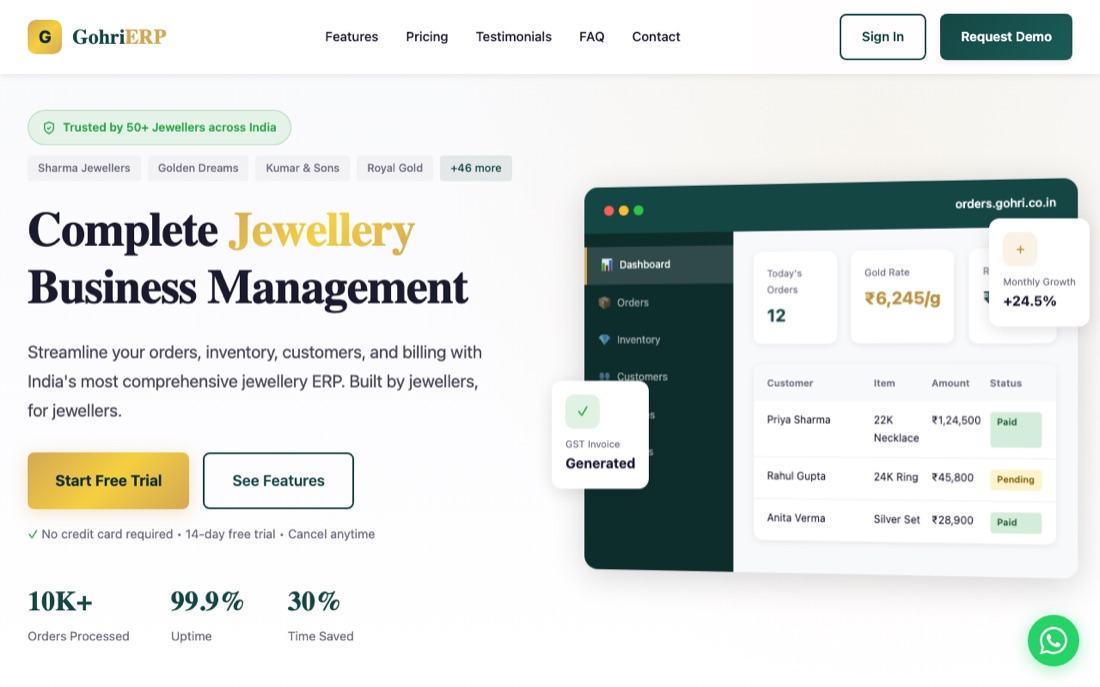
Gohri ERP

A multi-tenant ERP for jewellers, grown from a real shop’s order book.

“My father’s jewellery business ran on paper and memory. Now it runs on B2B and retail portals — and I’m building an AI pipeline that turns shop-floor photos into catalogue images.”

Started as an internal tool for Gohri Jewellers — orders, GST tax invoices and daily bullion rates — and grew over 600+ commits into a multi-tenant SaaS: inventory, customer CRM, OCR of rate circulars, price forecasting, WhatsApp campaigns and an AI design studio that turns a text description into a jewellery concept and an order.

safety & reliability

Moving from one shop to many meant every query had to be tenant-scoped. I wrote an automated audit that scans every database query for tenant filtering, used it to drive 24 unscoped queries to zero, and backed it with CSRF protection, rate limiting, hashed credentials and a test suite.

  • Node.js
  • Express
  • Postgres
  • OpenAI
  • OCR
  • PDFKit

forkd

An agent that plans your day around food and training.

“I wanted a meal planner that knew what was in my pantry and what my training week looked like. Nothing out there did both, so I built it.”

A personal nutrition and meal-scheduling PWA with a Claude-powered planner. It turns durable intentions — macros, pantry, time, training — into a concrete, checkable daily plan, and learns from what actually gets done.

safety & reliability

Built an eval harness of stress scenarios to test whether each planning preset genuinely behaves according to its stated priority rather than producing surface variation — gated on a written sign-off before opening to a second user. Trust is earned in order: be right, then small reversible actions, then consequential ones.

  • Next.js
  • TypeScript
  • Postgres
  • Claude API
  • PWA

trade

An automated trading system with an AI daily review.

“I trade gold, silver and Nasdaq futures, and I wanted a system I could trust. Same safety-first thinking I use at work — just with my own money on the line.”

Signals from TradingView are executed on a broker API by a Python service, with every decision logged to a live dashboard. An LLM reviews every session, pulls in relevant news and tests standing hypotheses.

safety & reliability

A kill switch and explicit arm/disarm states sit above everything. The AI review can never affect trading, and if its web search fails it stores nothing rather than a confident review with invented catalysts. Data egress is opt-in, and tool use is bounded to cap cost.

  • [Private]
  • [Kill switch]
  • [LLM review]
  • Python
  • Flask
  • Postgres
  • Claude API
  • Render

Engine / Life-OS

The framework behind forkd, generalised beyond food.

A daily-execution engine: take long-lived intentions, compile them into dated, checkable actions, and run an adherence loop that adapts the plan to what a person actually does.

safety & reliability

An agent only earns the authority to act after a long record of suggesting correctly — the design deliberately delays consequential actions until trust is demonstrated.

  • [In progress]
  • [Agents]
  • TypeScript
  • LLM agents

Experience

Eight years of ML in regulated settings

  1. 2022 — present

    Senior Data Scientist — Wealth AI · NatWest Group

    • Production GenAI system, evaluation framework and Model Risk / AI Ethics governance (above).
    • Supervised pricing, customer-lifetime-value and propensity models contributing to a ~10% increase in client inflows.
    • Line-manage three data scientists; set testing, code-review and reproducibility standards adopted beyond the team.
  2. 2022

    Data Scientist · Aviva

    • Risk-cost pricing model built to FCA compliance standards in a regulated insurance environment.
  3. 2021

    Data Scientist — Data Science for Social Good Fellowship · The Alan Turing Institute

    • Anomaly-detection model (XGBoost) for fraud and collusion in national public-procurement data — highly imbalanced, incomplete real-world data — reducing corrupt deals to under 2%.
  4. 2016 — 2020

    Senior Data Analyst · Wipro

    • Led a team of five on a customer-lifetime-value credit-line model driving 30% user-base growth.
    • Built an A/B-testing framework and Docker-based CI/CD for model deployment.

Off the clock

What I do when the screen goes dark.

The best ideas I’ve had came from being mildly irritated by my own life. Whether it’s an ERP for a real business or keeping frontier models honest, the goal is the same: build things that don’t fall apart when pressure hits.
contact.sh

$ echo $NEXT_ROLE

Working on AI safety or evaluation?

I’d like to hear about research engineering, evaluation and safety roles. CV available on request.